News
Data scientist predicts next season's sales at BESTSELLER
Published online: 30.03.2026

News
Data scientist predicts next season's sales at BESTSELLER
Published online: 30.03.2026
Data scientist predicts next season's sales at Bestseller
News
Published online: 30.03.2026
News
Published online: 30.03.2026
By Astrid Helene Mortensen, AAU Communication & Public Affairs
“I don’t need to know whether it’s a white T-shirt from Pieces. I just need the numbers.”
That’s how Morten Kaaber describes his work in the fashion industry. Because even though he works daily in a world of colours, trends, and collections, it’s not the fabric, the cut, or the style that fascinates him - it’s the data behind it.
Morten Kaaber is a data scientist at BESTSELLER - Denmark’s largest fashion company, home to brands like Jack & Jones, Vero Moda, and Name It. But his job is not to spot next season’s colour trend. His job is to build systems that predict exactly how much clothing should be produced, long before anyone has even seen the collection.
If BESTSELLER orders too much, the surplus ends up in outlets for a fraction of the price. If they order too little, sales teams are left empty-handed when stores want more. And all of this happens far in advance - from order to store takes at least 16 weeks. The clothes must be produced abroad, sewn, packed, and shipped to Denmark.
This is the problem Morten Kaaber is working to solve - using machine learning.
The idea is simple to explain but complicated to build: Instead of one person sitting with an Excel sheet trying to remember how a similar style sold two years ago, the algorithm gathers all historical sales data across thousands of styles and brands. And when a new style appears, the model can ask:
What have similar styles sold for? Who bought them? When did they hit the market?
Even details like colour are encoded. A white T-shirt isn’t just “white” - it is mapped to a coordinate on the colour wheel, allowing the machine to detect nuances and patterns a human would never think to look for.
“That’s the beauty of it,” Morten Kaaber says. “I don’t need to know whether it matters that it’s light blue instead of dark blue. I can feed it all into the model, and it figures out for itself what has historically made a difference.”
The model isn’t perfect, Kaaber emphasises. Never on the first attempt.
But it is now running in production at BESTSELLER, and employees who previously worked in the dark now get a qualified starting point: How do we think this style will sell?
And an unexpected side benefit has emerged: if the algorithm holds, the company produces exactly what’s needed. Not more, not less. Good for the bottom line - and good for the climate.
Facts about the programme in Mathematical Engineering (BSc)
Morten Kaaber ended up in the fashion industry almost by coincidence. He chose mathematical engineering at AAU because he wanted to combine mathematical rigour with something more applied. He never expected to spend his days predicting the sales of winter jackets and white T-shirts.
But that’s exactly the point, he says:
“You’re not locked into a specific industry with this degree. As long as companies have data, you’re useful - whether it’s fashion, postal services, or the public sector. You have some data, and you want to predict something. You can do that anywhere.”
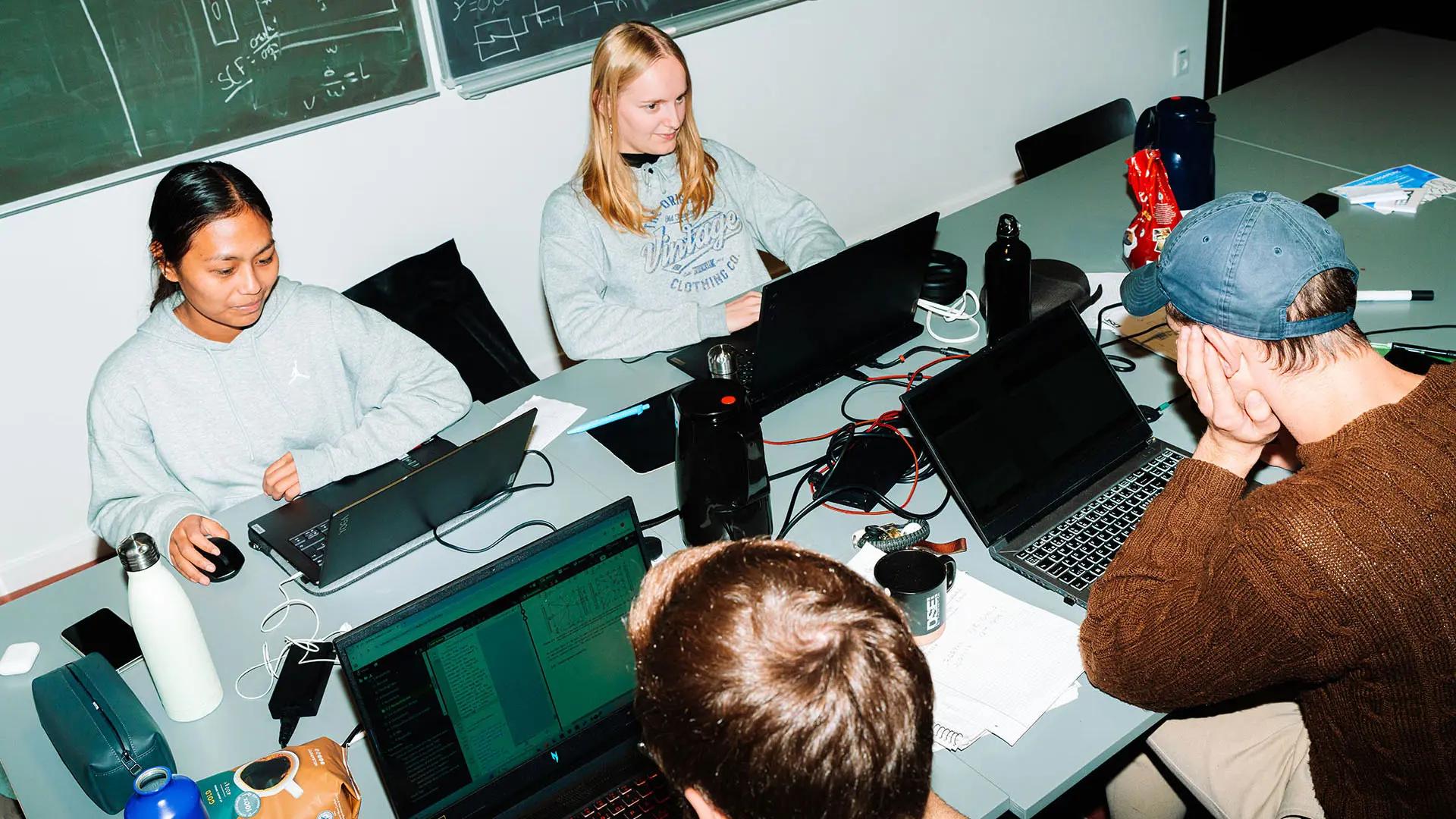
In the Bachelor's degree program in Mathematical Engineering, you learn to solve important tasks for society using mathematical models, calculations, and engineering. The tasks can be anything from reducing noise in hearing aids to improving traffic in a big city.