News
New Associate Professors Strengthen Mathematical and Statistical Health Research
Published online: 08.09.2026
News
New Associate Professors Strengthen Mathematical and Statistical Health Research
Published online: 08.09.2026
New Associate Professors Strengthen Mathematical and Statistical Health Research
News
Published online: 08.09.2026
News
Published online: 08.09.2026
By Olivia Griffin, AAU Communication & Public Affairs
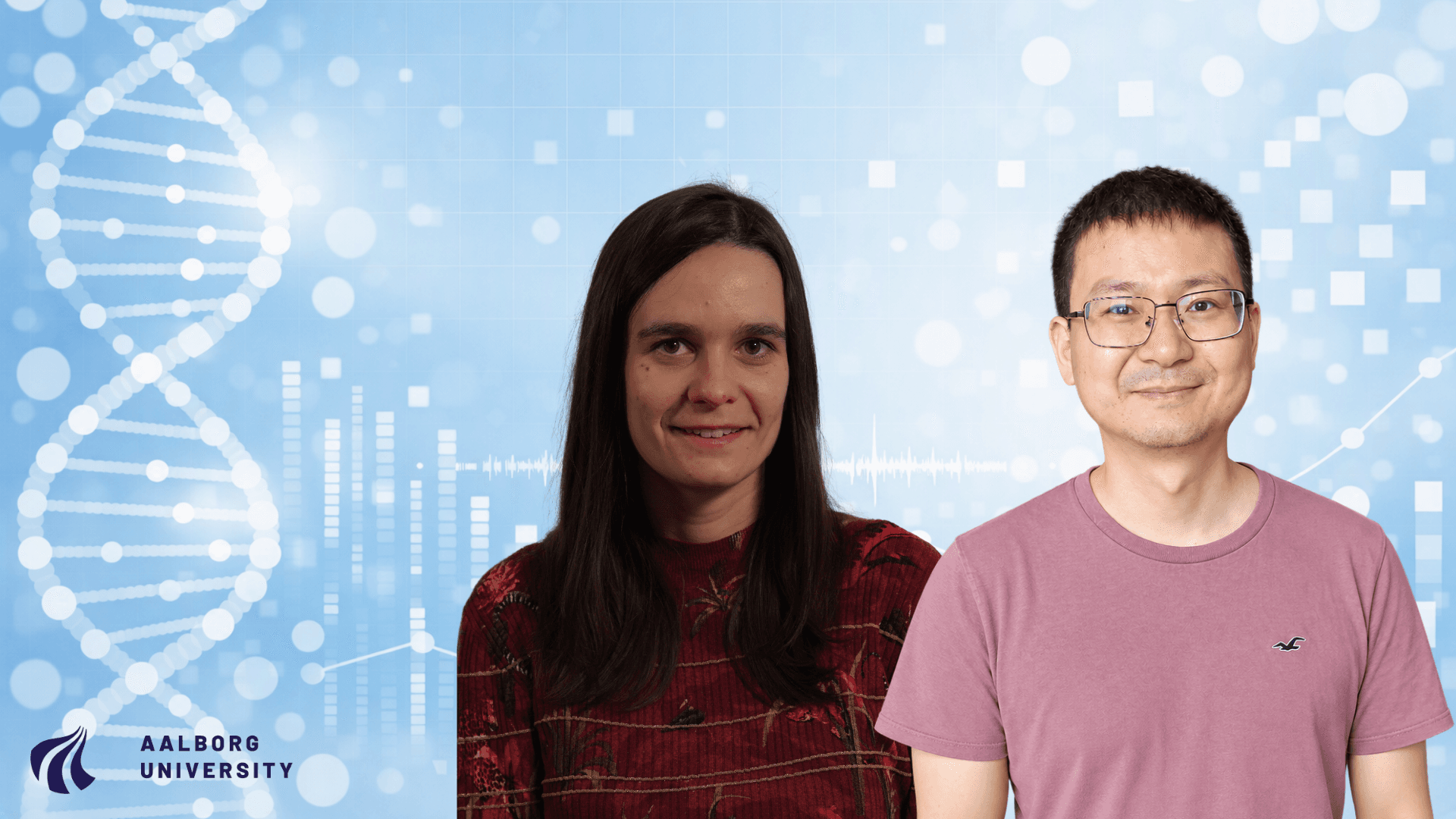
Both Lu Cheng and Marta Pelizzola work with advanced mathematical and statistical approaches to create new knowledge about biological processes and diseases, each from their own disciplinary angle.
Lu Cheng works at the intersection of mathematics, statistics, machine learning, and molecular biology. A central part of his research focuses on nanopore sequencing, where electrical signals generated as individual RNA molecules pass through a nanopore are translated into molecular profiles. These signals can be used to address important biological questions, such as identifying active microbes in environmental soil samples, detecting RNA modifications associated with disease, and understanding RNA structures that can help guide the design of mRNA vaccines and medicines.
He also uses large language models to identify genes that drive angiogenesis – the formation of blood vessels – research that may ultimately contribute to new treatment strategies for cardiovascular diseases. Describing the core of his approach, he explains, “My research is about developing machine learning and statistical methods to answer biological questions. How to utilize large language models to make interesting biological discoveries is a key question.”
Marta Pelizzola conducts research in statistical genetics and develops methods for analysing genetic, genomic and clinical data.
Her work includes statistical method development for cancer genomics, where she investigates the biological processes underlying specific cancer types and the relationships between mutations and disease. According to her, the most exciting projects “are the ones where somebody looks at a real problem from the data point of view, and then we make sense of it with a theoretical approach.”
The goal is to generate knowledge that clinicians, biologists and researchers can use to improve diagnostics and deepen understanding of disease development. As she describes it, “I try to understand which processes have generated a certain cancer. In the long run, methods like these can be used by medical doctors, clinicians and researchers in biology to analyse data and understand whether certain mutations are associated with that specific cancer.”
Despite their different academic approaches, Cheng and Pelizzola share a commitment to translating complex data and theoretical methods into biologically and clinically relevant knowledge.
And they both look forward to becoming part of the strong interdisciplinary environment at AAU.
Pelizzola highlights the collaboration with CLINDA – Center for Clinical Data Science – as an area with great potential. She is also eager to bring an applied perspective into her teaching through AAU’s problem-based learning model.
Cheng aims to strengthen the integration of programming and artificial intelligence in teaching and looks forward to engaging students in the methods that drive his research.
With the appointment of Lu Cheng and Marta Pelizzola, Aalborg University reinforces its position within data‑driven health research. Together, they represent a shared ambition: to use mathematics and statistics to understand biological systems – and to translate this knowledge into solutions that can make a difference for both science and society.
About the Associate Professors
Career:
Career: