News
Jonas’s Journey from Mathematical Engineering to Real-World Data Science
Published online: 06.03.2026

News
Jonas’s Journey from Mathematical Engineering to Real-World Data Science
Published online: 06.03.2026
Jonas’s Journey from Mathematical Engineering to Real-World Data Science
News
Published online: 06.03.2026
News
Published online: 06.03.2026
By Astrid Helene Mortensen, AAU Communication & Public Affairs
When Jonas Rabjerg Mikkelsen started his bachelor’s in Mathematical Engineering back in 2016, he had no idea just how directly his education would feed into real‑world problem‑solving. Today, his work spans everything from predictive heating optimization and ESG automation to data‑driven fashion forecasting. His career story is a compelling example of how a degree in Mathematical Engineering can open many doors.
Although the programme wasn’t large, Jonas Rabjerg Mikkelsen quickly discovered that Mathematical Engineering offered something unique: close industry connections. During his Master’s, he worked with Oticon on acoustic technology - a partnership made possible through a university-affiliated professor.
Then came the pandemic. With teaching shifting online, Jonas Rabjerg Mikkelsen decided to make the most of the sudden flexibility. He moved to Silkeborg and spent his final study year physically embedded at Kamstrup, working as a student researcher. There, he completed both a project and his master thesis using Kamstrup’s data and equipment.
“I couldn’t be paid as a master's student, but the value was access - to data, to equipment, to a real R&D environment.”
These experiences served as a launchpad for his first full‑time jobs.
After graduating, he joined WhiteAway Group, where his focus was analysing user behaviour on the company’s e‑commerce platform. His insights supported developers in optimizing the online shopping experience and guiding customers toward the right products.
Soon, he transitioned into a role that aligned even more naturally with his analytical background: Data Scientist at ReMoni.
At ReMoni, he worked at the intersection of data, sustainability, and automation. The company helps organisations understand and reduce consumption across electricity, water, and heat. He was involved in building several of ReMoni’s core products from the ground up, including predictive heating optimization, automatic ESG reporting and anomaly detection and alerts.
Recently, Jonas Rabjerg Mikkelsen stepped into a new role at DK Company, one of the major players in Scandinavian fashion. His mission is ambitious: Build a new data product that helps the business buy smarter - predicting demand across brands, categories, and seasons.
The goal is to avoid overproduction, reduce waste, and optimize stock levels by using:
Even in fashion - a world many assume is purely creative - Jonas has found big opportunities for mathematical modelling.
Fact box
When asked what he uses most from his degree, Jonas Rabjerg Mikkelsen doesn’t hesitate:
Jonas Rabjerg Mikkelsen often found that his understanding of theory made it easier to guide projects and collaborate across teams - especially with software developers.
“It was easier for me to understand their work than for them to understand the most theoretical parts of mine.”
Mathematics Engineering gave him a mindset that every problem has a structure - and a mathematical door through which it can be solved
From hearing‑aid acoustics to smart‑building automation to fashion forecasting, Jonas Rabjerg Mikkelsen’s career demonstrates a powerful truth: A strong theoretical background in mathematics can unlock almost any industry - especially when paired with practical programming skills and a willingness to refine real-world problems.
His journey is a testament to how analytical skills don't limit your career path - they broaden it.
Facts about the programme in Mathematical Engineering (BSc)
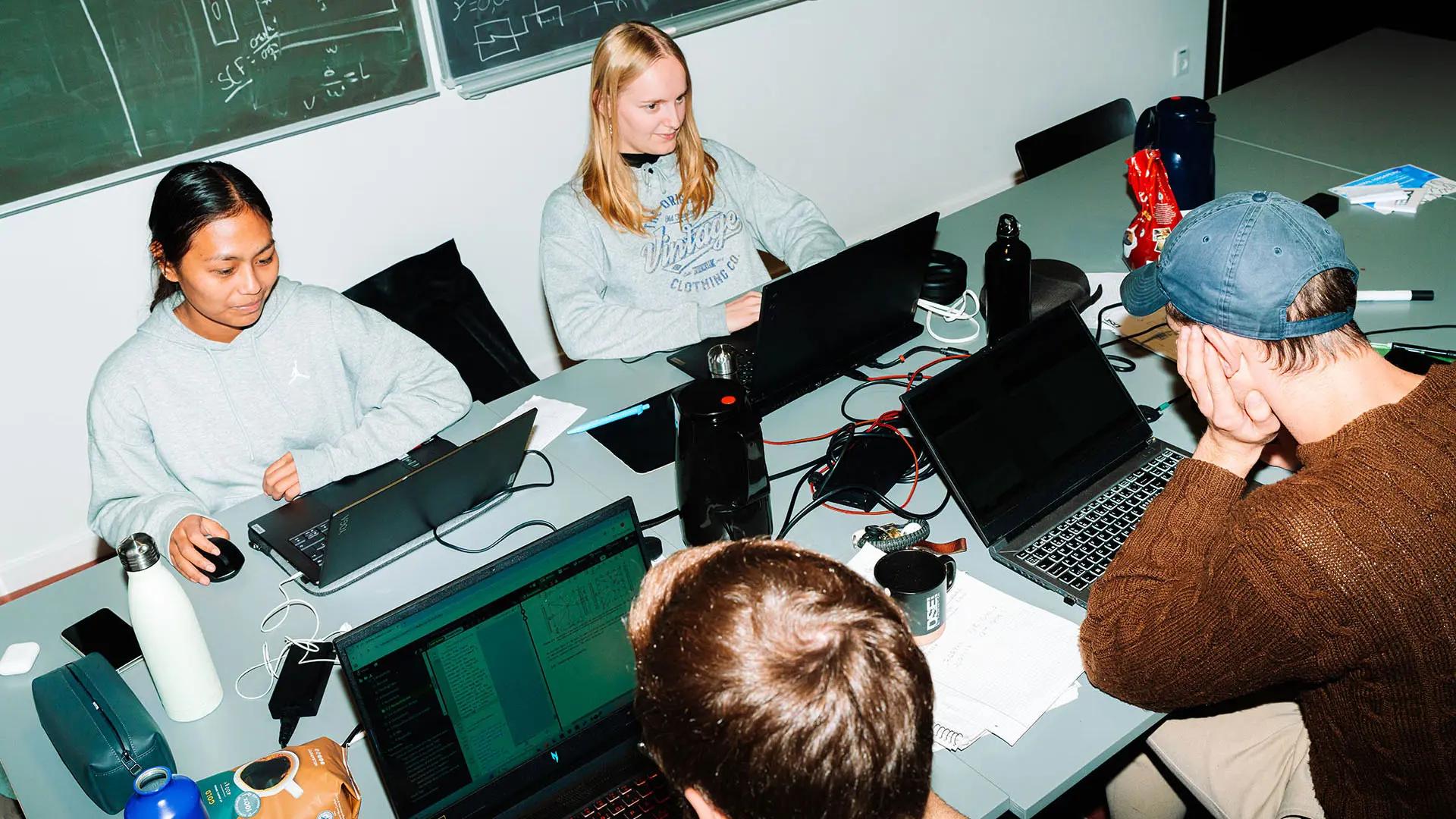
In the Bachelor's degree program in Mathematical Engineering, you learn to solve important tasks for society using mathematical models, calculations, and engineering. The tasks can be anything from reducing noise in hearing aids to improving traffic in a big city.